
The AmeriFlux community is gearing up for the upcoming Chapman Conference, where experts will gather to grapple with the energy balance closure problem, a pressing issue that has puzzled scientists for decades. In this blog post, we’ll delve into the heart of the problem, exploring what it is and why it matters.
Defining the Energy Balance Closure Problem
Eddy covariance is widely appreciated as a method for directly measuring the exchange of gases, water vapor, and energy between the atmosphere and terrestrial ecosystems. However, researchers often encounter a discrepancy when calculating the energy balance from measured energy fluxes and the expected available energy. The sum of the measured sensible and latent heat fluxes often fails to match the available energy to the ecosystem, which is typically represented by the net radiation minus the soil heat flux. This discrepancy is known as the energy balance closure problem. Its magnitude can range from 10% to 30% or more, depending on the site characteristics, environmental conditions, time scales, instrumentation, and data processing. The problem has been observed at numerous eddy covariance sites worldwide.
Why It Matters
So, why is the energy balance closure problem such a significant concern? The answer lies in the importance of accurate energy and flux measurements for understanding ecosystem functioning and Earth system processes. Eddy covariance data are crucial to validate land surface models. If the energy balance is not closed, it implies biases in the measured energy and potentially other fluxes, which can have far-reaching consequences for Earth system modeling and prediction. The surface energy budget determines how much energy is available to evaporate water and moisten the atmosphere. Air-sea energy fluxes set the thermal structure of the oceans, which in turn act to redistribute energy around the planet, and closing the energy balance is key to developing better models of these processes, as well as improving our understanding of ecosystem processes, such as evapotranspiration, photosynthesis, and respiration. By accurately measuring energy fluxes, researchers can gain insights into the complex interactions between the atmosphere, vegetation, and soil.
As the Chapman Conference approaches, experts will gather to discuss new insights and approaches for the energy balance closure problem. Registration is still open for those interested in attending and contributing to the discussion. By exploring innovative approaches and sharing knowledge, we can work towards resolving this pressing issue and advancing our understanding of ecosystem energy fluxes.
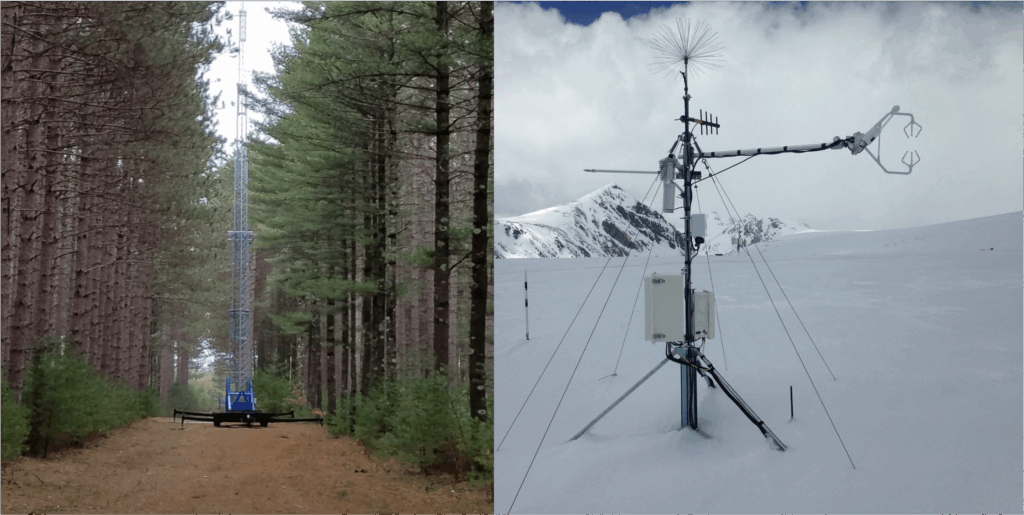
Site photos from US-CS2 (Credit: Jonathan Thom) and US-NR4 (Credit: John Knowles)
No Comments
Be the first to start a conversation