
AmeriFlux Rapid Response loaner enables monitoring of carbon flux dynamics from a rapidly thawing retrogressive thaw slump in Arctic Alaska
Kyle A. Arndt1, Susan M. Natali1, Patrick Murphy1, Christina Minions1, Kaj Lynöe1, Amanda Young2, Mayra Melendez Gonzalez2, George Kling3, Kevin Griffin4, and Jennifer Watts1
1 Woodwell Climate Research Center, Falmouth MA
2 University of Alaska Fairbanks, Fairbanks AK
3 University of Michigan, Ann Arbor, MI
4 Columbia University, New York, NY
Retrogressive thaw slumps (Figure 1) occur when ice-rich permafrost, soils that have been frozen for millennia, thaw rapidly causing landscape collapse. Permafrost soils are exceedingly carbon rich, containing approximately double global biomass or the current atmospheric concentration with over 1300 Pg C in the top three meters. Rapid thawing of permafrost is like opening the freezer allowing this carbon to be released to the atmosphere in the forms of carbon dioxide and methane, exacerbating climate warming, referred to as the permafrost-carbon feedback. With the generous support of the AmeriFlux Rapid Response equipment loaner program, we were able to instrument a rapidly growing retrogressive thaw slump occurring about 10 km south of Toolik Field Station, an Arctic research station operated by the Institute of Arctic Biology at the University of Alaska, Fairbanks, on the North Slope of Alaska (AmeriFlux ID: US-RTS; 68.527202°N 149.549089°W, https://ameriflux.lbl.gov/sites/siteinfo/US-RTS).

Figure 1: From left to right: location of US-RTS in the state of Alaska just north of the Brooks Range; an aerial photo of the retrogressive thaw slump (RTS) with the tower in the lower left side (Photo: Andrew Mullen); Dr. Jennifer Watts taking chamber flux measurements from various disturbed cover types within the RTS (Photo: Anne Yutrenka).
This retrogressive thaw slump has been growing at a rapid rate, thawing ~40 m per year from the headwall. Rarely before have flux measurements been taken in retrogressive thaw slumps, especially one currently thawing and never year-round. By utilizing the loaner program, we were able to instrument the site in May of 2025 (Figure 2), to be able to access the site by snowmachine, bringing equipment in on sleds across the 10 km of tussock tundra buried under snow. During site establishment, temperatures ranged from -25 to 5 degrees Celsius with a race against snowmelt for site access with snow disappearing from the tundra as spring temperatures arrived.
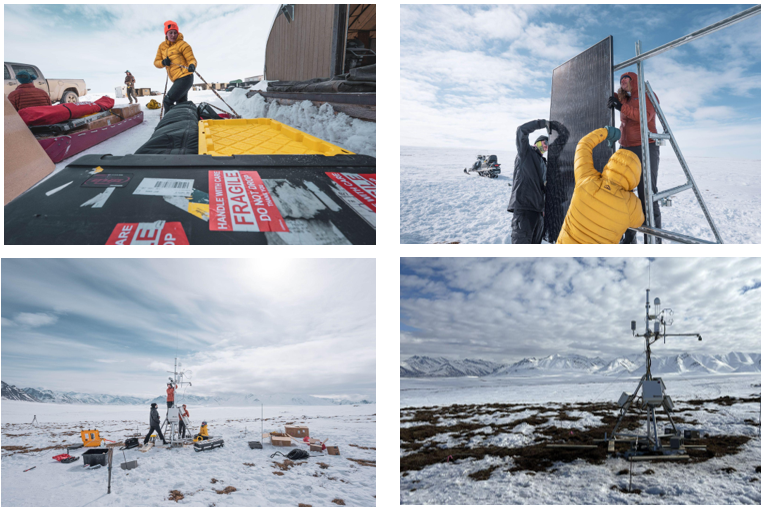
Figure 2: Photos of the spring set-up of US-RTS (Photos courtesy of Jayme Dittmar unless otherwise noted). Upper left; Christina Minions loading sleds of equipment ready to pull out to the field site. Upper right; Dr. Kyle Arndt, Dr. Jennifer Watts, and Christina Minions mounting solar panels to power the flux tower. Lower left; Woodwell Climate team (Dr. Kyle Arndt, Dr. Jennifer Watts, Kaj Lynoe, and Christina Minions) mounting equipment on the tripod. Lower right; The completed establishment of US-RTS (Photo: Dr. Kyle Arndt)
Site placement was to the north of the thaw slump for two reasons: the headwall and direction of thaw is primarily to the west and thus the north side of the slump was considered to be a safer side of the slump where the tower may not have to be moved in following years; and the primary wind direction is from the south, meaning that most of the time the flux footprint will be over the thaw slump (“experiment side”) and the rest of the time it will mostly be from the in-tact moist acidic tussock tundra to the north (“control side”). This way, with one tower site, we are able to run an experiment to test controls of and magnitude of carbon fluxes from the thaw slump (Figure 3).
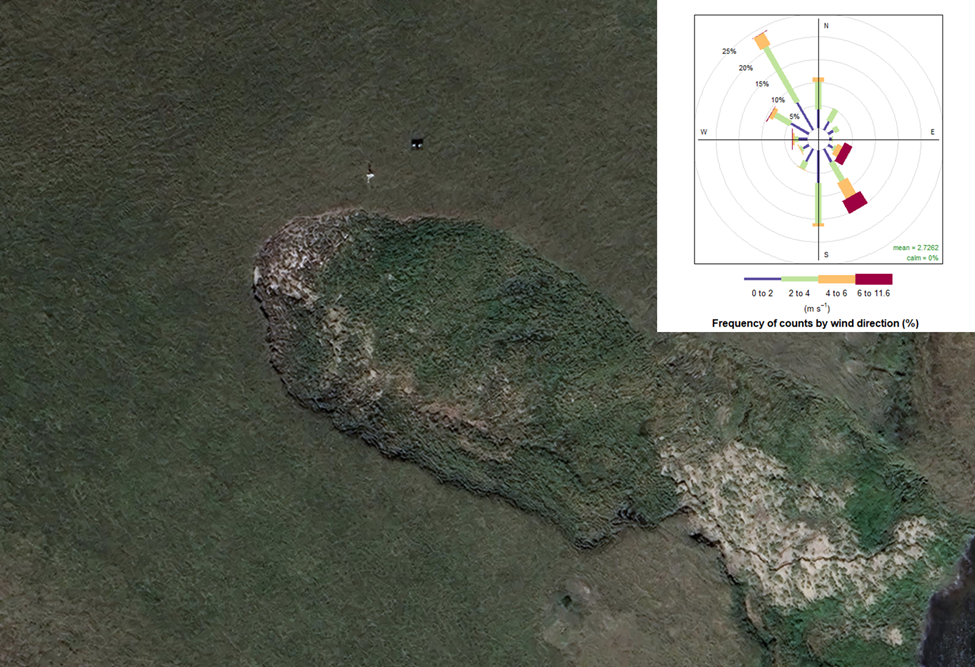
Figure 3: Satellite image of US-RTS and a windrose showing the primary wind directions from the south and north.
From the initial growing season of carbon fluxes measured at US-RTS, patterns of enhanced biogeochemical cycling were evident. There was increased variability in net ecosystem exchange (NEE) from the thaw slump compared to in-tact tundra when analyzed via a light response curve (Figure 4), however night time respiration was significantly higher from the southern slump fluxes. Methane fluxes and ecosystem respiration (Reco) were significantly higher from the slump given similar temperatures and had a more sensitive temperature response. Gross Primary Productivity (GPP) was also higher from the slump in a light response function showing all slump fluxes to be more sensitive to primary flux controls. This highlights the need for further research to explain what is driving the enhancement of biogeochemical cycling in the thaw slump compared to intact tundra.
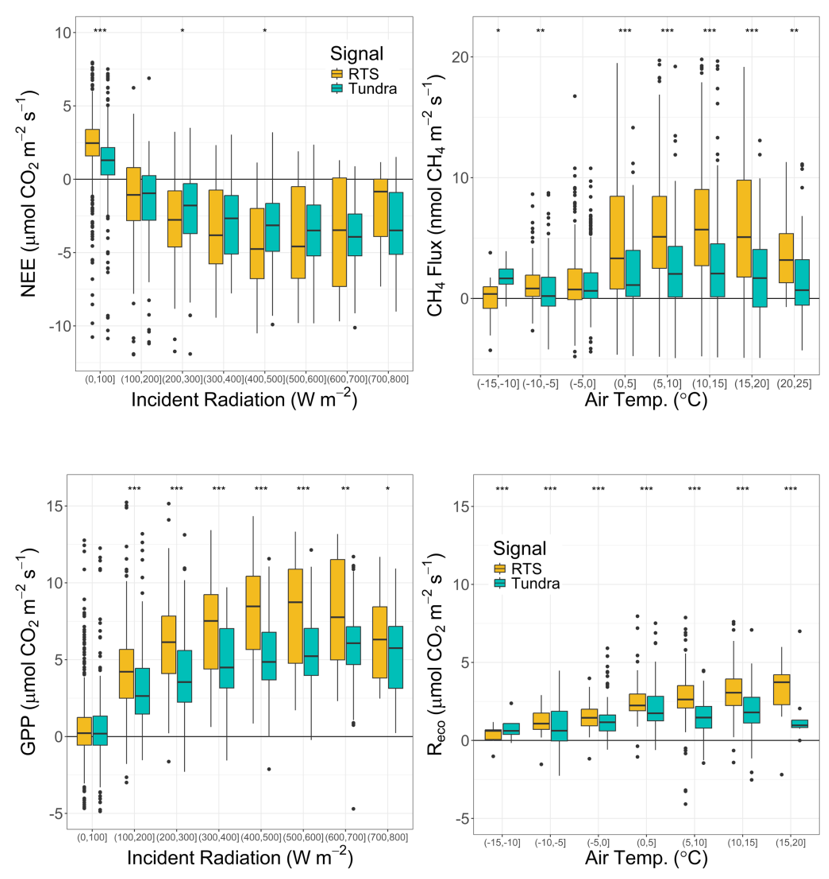
Figure 4: Net ecosystem exchange (NEE), methane (CH4) flux, gross primary productivity (GPP), and ecosystem respiration (Reco) binned by their primary control of either incident short-wave radiation or air temperature.
The loaner equipment from AmeriFlux enabled us to leverage a small grant to collect initial experimental data at this rapidly developing site. Initial results show promising future directions for research and answers questions on the implications of these disturbances on the permafrost-carbon feedback.
Visit our website to learn more: https://www.woodwellclimate.org/project/alaska-extreme-thaw-observatory/
Acknowledgments: This project was made possible with generous support from the AmeriFlux Rapid Response equipment loaner program. Financial support was provided by the Fund for Climate Solutions at the Woodwell Climate Research Center and through funding catalyzed by the TED Audacious Project (Permafrost Pathways). Additional support was generously provided from the NSF-supported Arctic LTER program and Toolik Field Station.
No Comments
Be the first to start a conversation